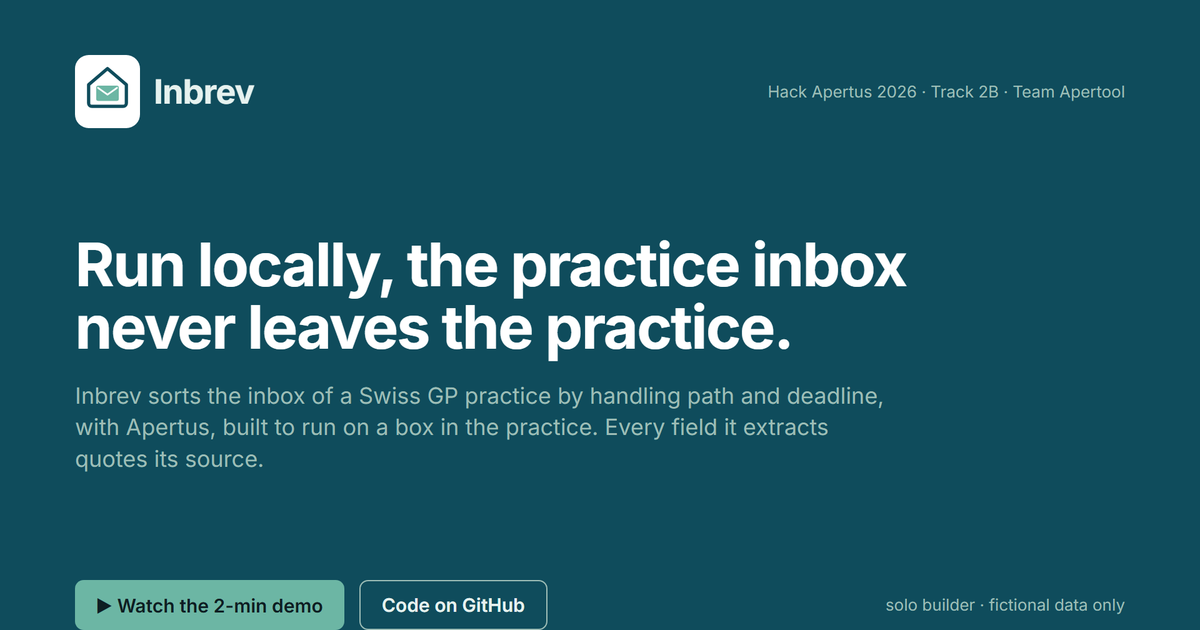
Hack Apertus 2026 · Track 2B · Team Apertool

Run locally, the practice inbox never leaves the practice.

Inbrev sorts the incoming e-mail, web forms and faxes of a Swiss general practice with Apertus, built to run on a box inside the practice. Every message gets a handling route, an administrative deadline and a person in charge, and every decision points to the words in the message that support it.

The problem

Practice staff start the day with a mixed pile: lab reports, prescription requests, appointment changes, insurer forms, referrals and advertising, in German, French and Italian.

9.5 h

per week of administration for Swiss family physicians in 2025, up from 8.6 h in 2020.

Zeller et al., Praxis 2026, n = 1,776
54 min

per day that physicians in private practice spend on requests from authorities and insurers.

gfs.bern survey for FMH 2025, N = 1,532
Art. 321

Swiss Criminal Code: professional secrecy binds physicians and their assistants. Patient mail should not leave the practice.

SR 311.0

Read, route, prove

A fixed pipeline, not an agent. Apertus reads free text in four languages; plain code checks everything it says.

  1. Read. E-mail (files or IMAP, tested on a local test server), web forms and fax PDFs (OCR; on 60 rendered fax pages 50 routes right, 56 on clean text) become text; a HIN connection is planned (not tested yet). Apertus answers in an enforced JSON schema, three times per message.
  2. Route. One of nine administrative routes, a deadline computed in code from the quoted date, and the person in charge: assistant, doctor or administration.
  3. Prove. Every field needs a verbatim quote that exists in the message. No quote, no value. The inbox highlights the source.

Routes, does not triage

In its default mode Inbrev does not assess clinical content. A message that may contain symptoms is excluded from automation and lands with the messages a person decides, in order of arrival and without any ranking by severity. That keeps the tool administrative.

A person decides when Inbrev is unsure

If the three samples disagree, the model calls a message ambiguous, or no evidence survives the checks, Inbrev does not guess. The message lands in "A person decides".

The app

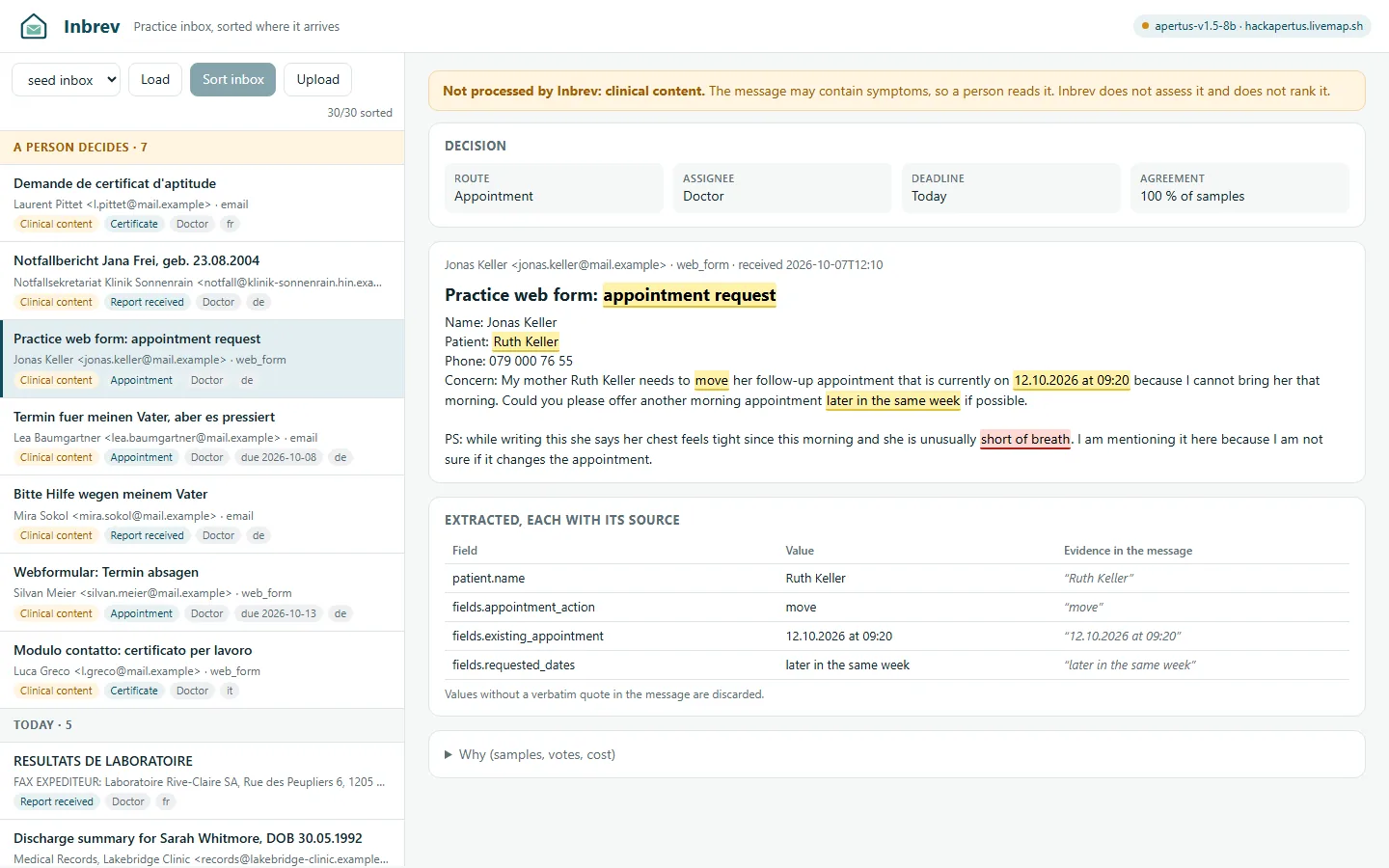
Screenshots of the running web inbox with stored Apertus 8B results on fictional test messages. Highlighted words are the quotes the decision rests on.
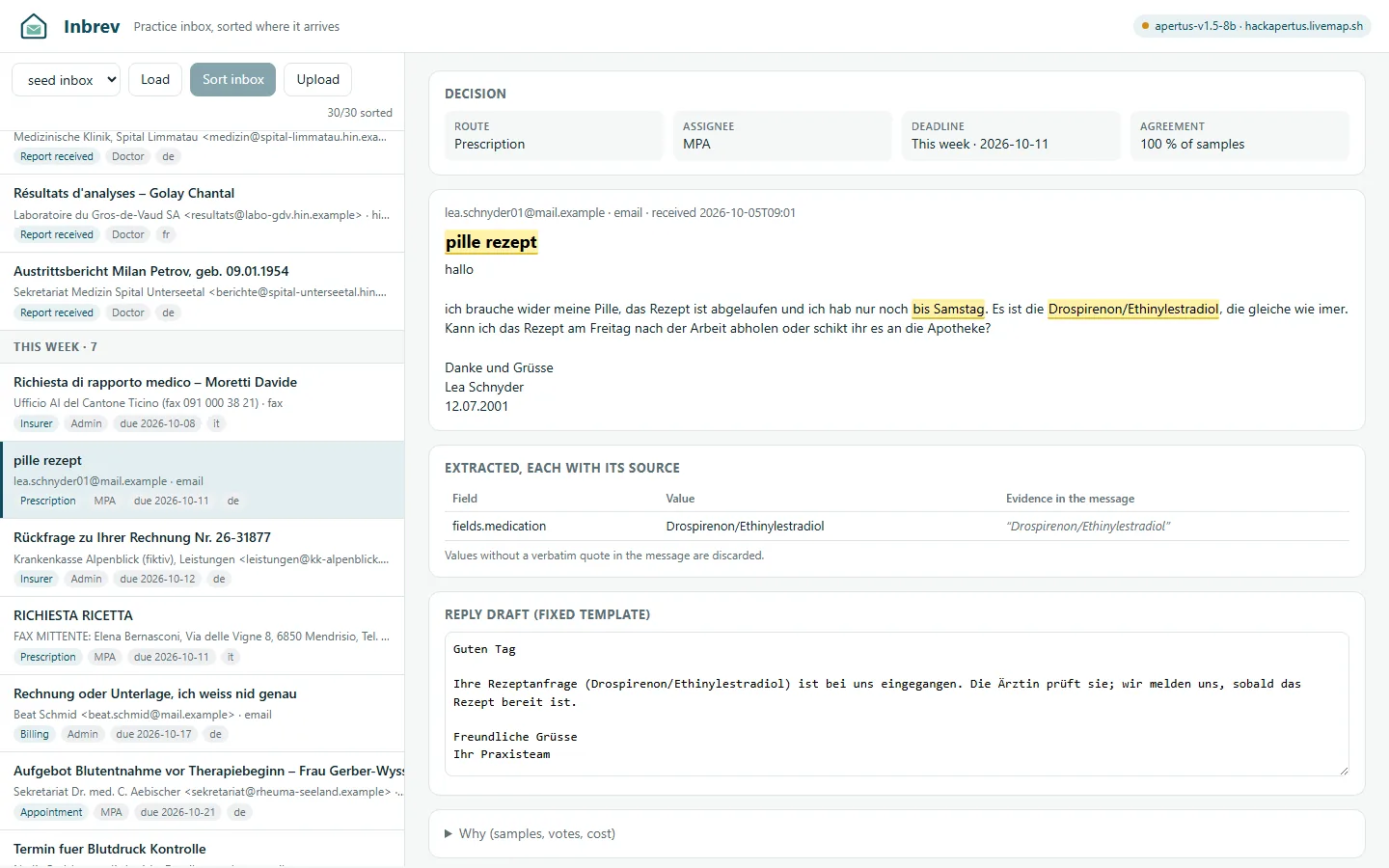
Inbrev inbox: a prescription request routed to the assistant, deadline this week, medication quoted from the message, fixed reply template
Prescription request: route, assignee and deadline, each value with its quote; reply from a fixed template.
Inbrev inbox: an appointment request that mentions shortness of breath is not processed and goes to a person
Appointment request that mentions shortness of breath in passing: not processed, a person reads it. No ranking.

Runs where the mail arrives

Inboxe-mail · fax · form
Apertus 8Blocal weights, JSON schema
Checks in codequotes · dates · vote
Sorted inboxwith sources · audit log

Everything inside the dashed line runs in the practice. The model host needs no internet connection at runtime.

On-premise

A mini PC in the practice. Measured on a laptop before the symptom pass was added: 192 s per message on the CPU, 62.7 s on its integrated GPU (30 messages). With the symptom pass (default): 71.8 s on the integrated GPU, 16 of 16 clinical messages excluded (30 messages). 60 messages a day fit either way; sorting runs as mail arrives.

Air-gapped

The same box without any network route to the outside; only a mail gateway hands messages in.

Swiss cloud

For single-doctor practices: a sovereign Swiss provider under Swiss jurisdiction.

Status

What is built, what is measured and what is still open. Every number comes from a real run on synthetic, fictional messages whose labels one person from the team has checked on a sample of 60 messages (κ 0.98 route, 1.00 clinical content).

Built

  • Pipeline with enforced schema, quote checks, deadline rules and abstention
  • Web inbox with highlighted sources and a JSON API
  • Unit tests and the non-LLM evaluation run in Docker with --network none
  • Taxonomy of nine routes, 12 seed messages written by Claude (not by hand) and a synthetic test set of 180 messages in four languages written by Claude and GPT-5.5, all fictional
  • Measured on the 180 messages with prompt p3 alone: Inbrev with Apertus 8B takes 13 of 16 messages with clinical content out of automation (95 % CI 0.57–0.93), routes 170 of 180 correctly and handles 84 % automatically (a person only checks the suggestion and its quote). Apertus 70B: 15 of 16, route 172
  • Second, narrow check (since 13 Oct, chosen on a separate dev split, measured once on the 180): Apertus 8B asks only whether someone describes a current complaint. All 16 messages with clinical content now leave automation; 40 instead of 29 of 180 messages go to a person
  • Challenge set (115 messages written by an open model after prompt p3 was frozen, later part of the dev split for the second check; 44 with clinical content, 39 medical traps): with p3 Apertus 8B takes 41 of 44 out of automation (95 % CI 0.82–0.98), 70B 44 of 44, keyword rules 31 of 44
  • Baselines without a language model: keyword rules route 79 % correctly but catch only 7 of 16 messages with clinical content; a single Apertus 8B answer without the checks catches 9 of 16
  • Second labels from two open models (not people) on all 367 test messages: agreement with our labels κ 0.93 for the route and 0.97–0.98 for clinical content; no ranking changes when scored against their labels
  • Clinical reports written by people: 40 of 40 German (GraSCCo) and 37 of 38 French (PARHAF) routed as reports; most false clinical flags on them come from the keyword net
  • Fax pages read by OCR (60 messages): route 50 of 60 instead of 56 on clean text; unreadable pages go to a person
  • Other open models in the same pipeline do better than Apertus: Qwen3.5-9B and Ministral 8B route 177 of 180 and catch 16 of 16 (Apertus 8B 170 and 13, 70B 172 and 15). With the second check the clinical gap is closed; on routes Apertus still lets 8 of 180 errors through unnoticed, Qwen 1. We keep Apertus for its documented, opt-out-respecting training data and Swiss origin, and say what that costs (see the report)
  • Fresh hold-out (146 messages written by Gemma 4 31B, frozen with hashes before any run): Apertus 8B lets 5 wrong routes run automatically and sends 40 to a person, Qwen3.5-9B 0 and 24. Sharper route descriptions and examples alone change nothing. Optional for practices with 70B access (e.g. a Swiss cloud): Apertus 70B as second opinion when keyword rules disagree, 3 wrong routes at 45 (INBREV_SECOND_OPINION_MODEL)
  • Full run without internet: Apertus 8B (Q4 weights, checksum logged) in llama.cpp and Inbrev on a Docker network with no route outside; an egress test fails as it should (192 s per message on a laptop CPU, before the symptom pass). The same weights on the laptop's integrated GPU: 62.7 s per message (30 messages), 38 of 44 clinical messages caught on the challenge set (both without the symptom pass)
  • Cost (model calculation from the measured time and an assumed box price): about CHF 12 per 1,000 messages on a mini PC at 60 messages a day (time measured before the symptom pass; the box, not the energy, dominates). Staff time saved is an assumption model, not measured (base case about 32 minutes a day)

In progress

  • Review of all labels by a person; so far one person has checked a sample of 60 and 36 disputed messages
  • Interviews and a timing trial in practices
  • Latency on a GPU in the practice

Demo video

The video shows the default mode on synthetic messages. Not in the video: two other open models of the same size route better than Apertus 8B in the same pipeline (177 vs 170 of 180); the report (§5) says what that costs and why we keep Apertus. “16 of 16” means 16 synthetic clinical messages (95 % CI 0.81–1.00).

Apertool logo

Team Apertool

One builder, four tools for Hack Apertus 2026. Inbrev is the Track 2B project.

Meet the team

Contact

Questions, ideas or feedback on Inbrev? Write to Team Apertool and we will answer by e-mail.

Please do not send patient information. Your name, e-mail address and message are forwarded to Team Apertool by e-mail only, solely to answer you; the form itself stores nothing and passes nothing on. This site uses no analytics and sets no cookies.